Hypertext Markup Language
- HT
- Hypertext means the text contains links to other documents or resources.
- M
- Markup is ?
- L
- A language is a system of communciation.
Building accessible interfaces with semantic HTML
A way of adding instructions to text to define structure, presentation, or meaning.
Originates from the publishing industry - typesetter's marks.
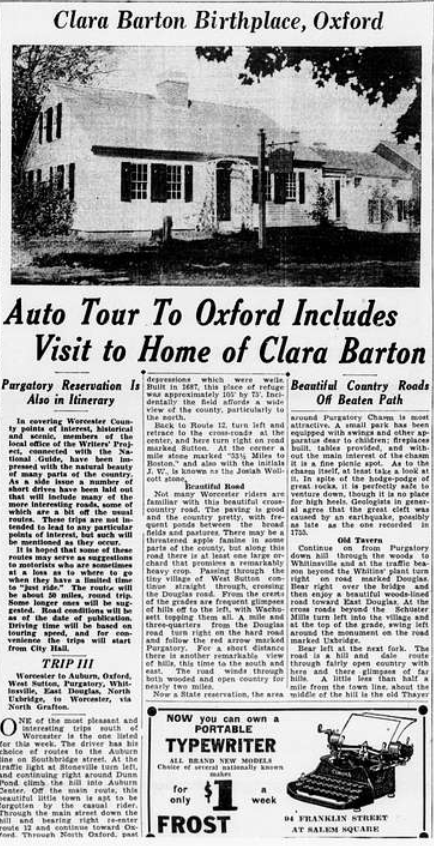
Auto Tour To Oxford Includes Visit to Home of Clara Barton

Purgatory Reservation Is Also in Itinerary

In covering Worcester County points of interest, historical local offices of the Writers' Project, connected with the National Guide, have been impressed with the natural beauty of many parts of the county. As a side issue a number of short drives have been laid out that will include many of the more interesting roads, some of which are a bit off the usual routes. These trips are not intended to lead to any particular points of interest, but such will be mentioned as they occur.

It is hoped that some of these routes may serve as suggestions to motorists who are sometimes at a loss as to where to go when they have a limited time to "just ride." The routes will be about 50 miles round trip. Some longer ones will be suggested. Road conditions will be as of the date of publication. Driving time will be based on touring speed, and for convenience the trips will start from City Hall.

Trip III

Worcester to Auburn, Oxford. West Sutton, Purgatory, Whitinsville, East Douglas, North Uxbridge, to Worcester, via North Grafton.

One of the most pleasant and interesting trips south of Worcester is the one listed for this week. The driver has his choice of routes to the Auburn line on Southbridge street. At the traffic light at Stoneville, turn left, and continuing right around Dunn Pond, climb the hill into Auburn Center. Off the main route, this beautiful little town is apt to be forgotten by the casual rider. Through the  main street down the hill and bearing right re-enter route 12 and continue toward Oxford, through North Oxford past depressions which were wells. Built in 1687, this place of refuge was approximately 105 by 73. Incidentally the field affords a wide view of the county, particularly to the north.

Back to Route 12, turn left and retrace to the cross-roads at the center, and here turn right on road marked Sutton. At the center a mile stone marked "33 miles to Boston" and also with the initials J.W. is known as the Josiah Wellcott stone.

Beautiful Road

Not many Worcester riders are familiar with this beautiful cross-country road. The paving is good and the country pretty with frequent posts between the broad fields and pastures. There may be a threatened apple famine in some parts of the county, but along this road there is at least one large orchard that promises a remarkably heavy crop. Passing through the tiny village of West Sutton continue straight through crossing the Douglas road. From the crests of the grades are frequent glimpses of hills off to the left, with Wachusett topping them all. A mile and three-quarters from the Douglas road turn right on the hard road and follow the red arrow marked Purgatory. For a short distance there is another remarkable view of hills, this time to the south and east. The road winds through both wooded and open country for nearly two miles.

Now a State reservation, the area around Purgatory Chasm is most attractive. A small park has been equipped with swings and other apparatus dear to children; fireplaces built, tables provided and without the main interest of the chasm it is a fine picnic spot. As to the chasm itself, at least take a look at it. In spite of the hodge-podge of great rocks, it is perfectly safe to venture down, though it is no place for high heels. Geologists in general agree that the great cleft was caused by an earthquake, possibly as late as the one recorded in 1755.

Old Tavern

Continue on from Purgatory down hill through the woods to Whitinsville and at the traffic beacon beyond the Whittins' plant turn right on road marked Douglas. Bear right over the bridge and then enjoy a beautiful woods-lined road toward East Douglas. At the cross roads beyond the Schuater Mills turn left into the village and at the top of the grade, swing left around the monument on the road marked Uxbridge.

Bear left at the next fork. The road is a hill and dale route through fairly open country with here and there glimpses of far hills. A little less than half a mile from the town line, about the middle of the hill is the old Thayer Tavern on the left. This interesting building with its huge chimney and fireplaces was once a station on the under-ground railway for escaping slaves. Continue through the next cross roads and then turn left on Route 22.

Hartford

From here head toward Worcester. At the junction of Routes 122 and 122A bear right with 122. Just beyond on the right a Tercentenary marker notes the trail over which Rev. Thomas Hooker led the little company which was to found what is now Hartford, Conn.

Follow 122 to Worcester. Distance, without side trips to the Barton Hotel or Huguenot Fort, a little more than 50 miles. For driving time figure about two hours over the through route.

Another trip next Sunday.
:h1 id='intr'.Chapter 1:  Introduction
:p.GML supported hierarchical containers, such as
:ol.
:li.Ordered lists (like this one),
:li.Unordered lists, and
:li.Definition lists
:eol.
as well as simple structures.
:p.Markup minimization (later generalized and formalized in SGML),
allowed the end-tags to be omitted for the "h1" and "p" elements.
A Gentle Introduction to SGML from Guidelines for Electronic Text Encoding and Interchange.
It's still the foundation of the web, no matter which tech stack you use.
Modern JS apps render HTML to the DOM.
Tags are about what it is, not what it looks like.
Semantic tags clearly define the meaning and purpose of the content they contain.
This helps assistive technology, search engines, and people understand the structure of the content.
It cannot be reached by keyboard.
It doesn't announce itself as a button.
It doesn't trigger a form submission.
It imparts meaning to the content inside.
The headings in a document define the outline and structure of the content.
Semantic HTML is your first line of defense.
<div> and <span> don't communicate meaning - they provide no structure or information about the content inside.
That's not a bad thing...sometimes to achieve the layout you want, you need extra containers that don't impart meaning.
Using exclusively <div>s and <span>s around content is a problem.
Divitis and spanitis.
Key takeaways